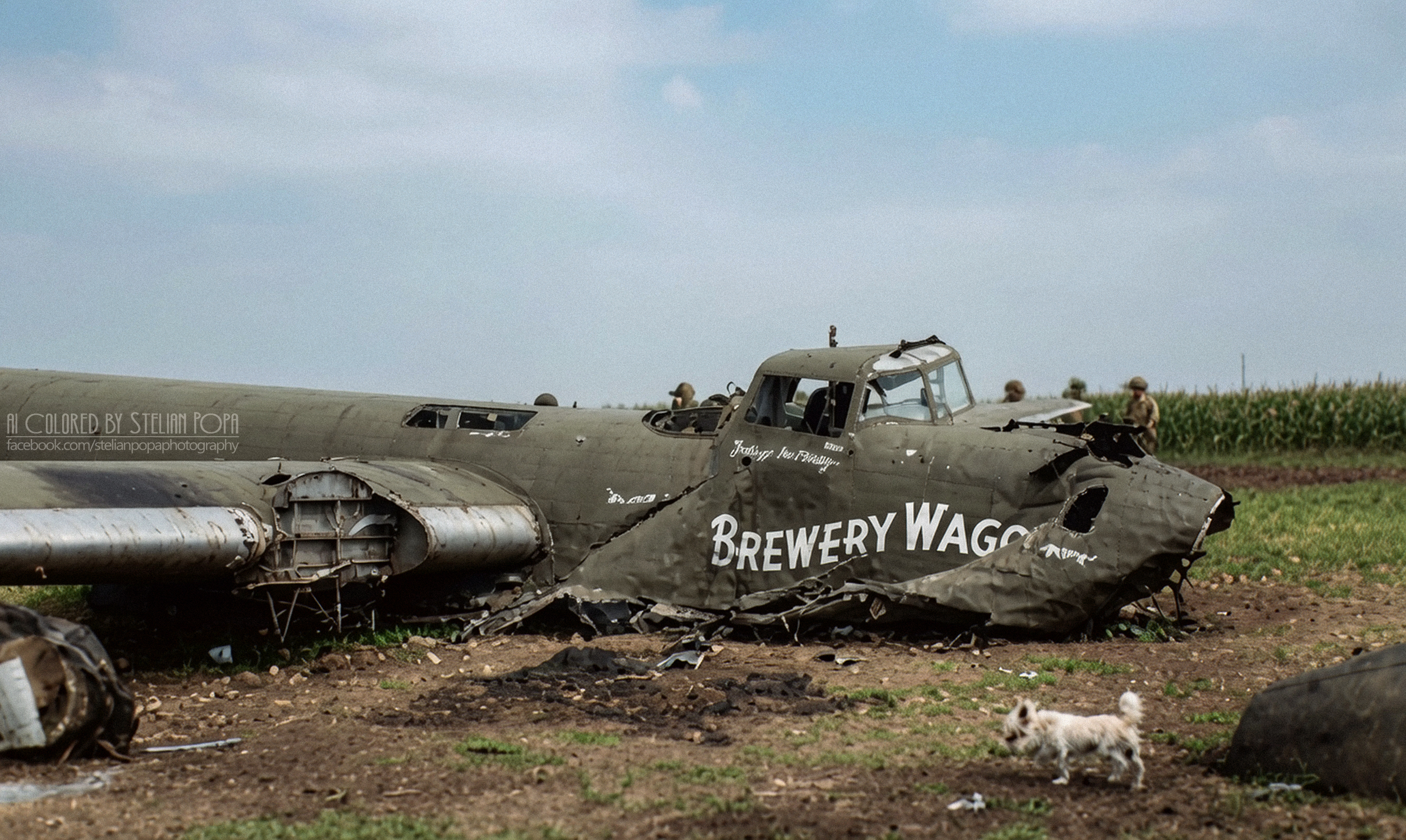
The B-24D Liberator Brewery Wagon flew in Operation Tidal Wave on August 1, 1943, the famous low-level raid against the oil refineries around Ploiești, Romania. Commanded by 1st Lt. John D. Palm, the aircraft was damaged by anti-aircraft fire before being shot down by a German Messerschmitt Bf 109 at 1:08 p.m. as it approached its target. Two crew members were killed. It was the first American bomber lost during Operation Tidal Wave.
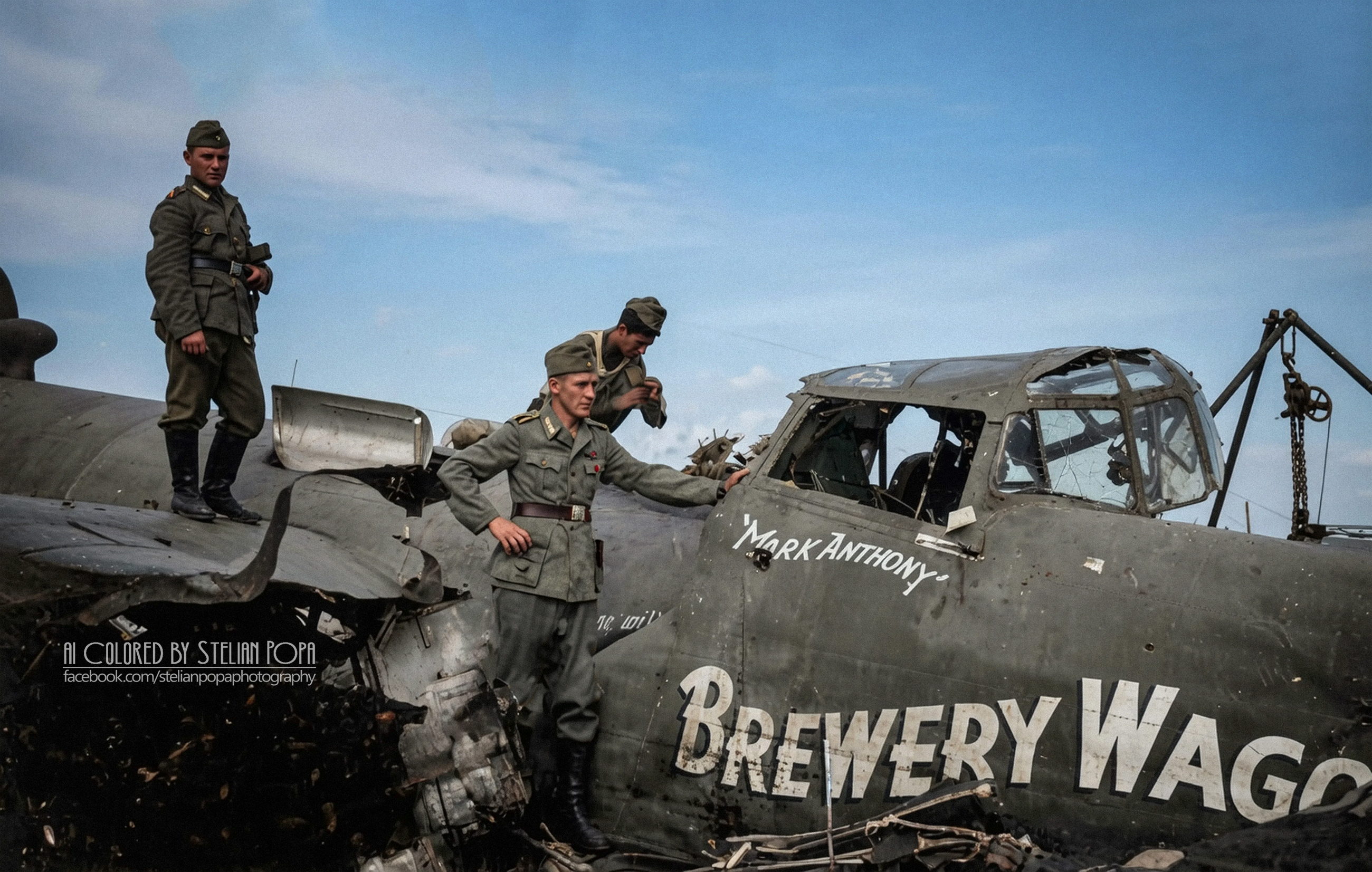
Bearing serial number 41-24294, Brewery Wagon served with the 512th Bomb Squadron, 376th Bomb Group. Delivered to the USAAF in December 1942, it was assigned to North Africa under the 9th Bomber Command.
According to William R. Bradley’s The Daring World War II Raid on Ploesti, the aircraft was named Brewery Wagon by its regular pilot, Lt. Robert H. Storz, whose father owned a well-known brewery in Nebraska.
The bomber flew its first combat mission on May 1, 1943, against Reggio, Italy. It soon developed a reputation for mechanical unreliability, with five of its first sixteen combat missions being aborted because of technical problems.
When Lt. John Palm and his crew were assigned the aircraft for what would become its seventeenth and final combat mission, they were unhappy with the assignment. One account even claims that a crew member threw stones at the fuselage in an attempt to remove the aircraft’s supposed “curse” before takeoff.
While flying toward Romania, Brewery Wagon maintained formation with two other bombers, Wongo Wongo and Desert Lily. During the Mediterranean crossing, Wongo Wongo suddenly went out of control, spun into the sea, and was lost with all hands aboard. Lt. Guy Lovine left formation to search for survivors but was unable to rejoin the raid and had to abort the mission.
A decisive moment of the operation occurred near Târgoviște, where the leading formation made a navigational error and turned toward Bucharest instead of Ploiești. Lt. Palm recognized the mistake and chose to continue toward the target on his own, demonstrating remarkable determination to complete the mission.
Flying at low altitude, Palm’s aircraft emerged from a rain cloud directly into intense anti-aircraft fire around Ploiești. A direct hit to the nose section likely killed bombardier 2nd Lt. Robert W. Merrell, who was flying his first combat mission, while navigator 2nd Lt. William M. Wright was mortally wounded. Additional hits destroyed one engine, damaged two others, and caused the overloaded B-24 to lose altitude.
Despite the severe damage, Palm pressed on with the attack, heading for the nearest refinery he could identify.
Moments later, Hauptmann Wilhelm Steinmann of JG 4 attacked the crippled bomber from behind in a Messerschmitt Bf 109G. The fighter’s cannon and machine-gun fire inflicted further damage. Co-pilot Lt. Love managed to activate the onboard fire extinguishing system, preventing the flames from spreading through the aircraft, but the bomber eventually crashed. The impact destroyed the forward section of the aircraft, killing the bombardier and navigator.
The surviving crew—including Palm, Love, flight engineer T/Sgt Alexander P. Rockinson, radio operator T/Sgt Harold Block, and gunners Austin D. Chastain, Clay E. Snyder, William E. Thompson, and Dallas A. Robertson—were captured by Romanian forces, who refused German demands to take custody of the American airmen.
Following Romania’s change of sides on August 23, 1944, Palm and the other American prisoners were released and transferred to Foggia, Italy, during Operation Reunion.
For his courage and determination in carrying out the mission, 1st Lt. John D. Palm was awarded the Silver Star.
Information sourced from this link